General News

Northern Lights: Aurora Visible Across the UK

The Aurora Borealis was visible throughout the United Kingdom on the evenings of 9 October and 10 October 2026. High levels of solar activity allowed the lights to be seen as far south as Kent, Hampshire, and Devon. This phenomenon occurred as activity levels reached 600nT on Saturday evening, according to BBC News.

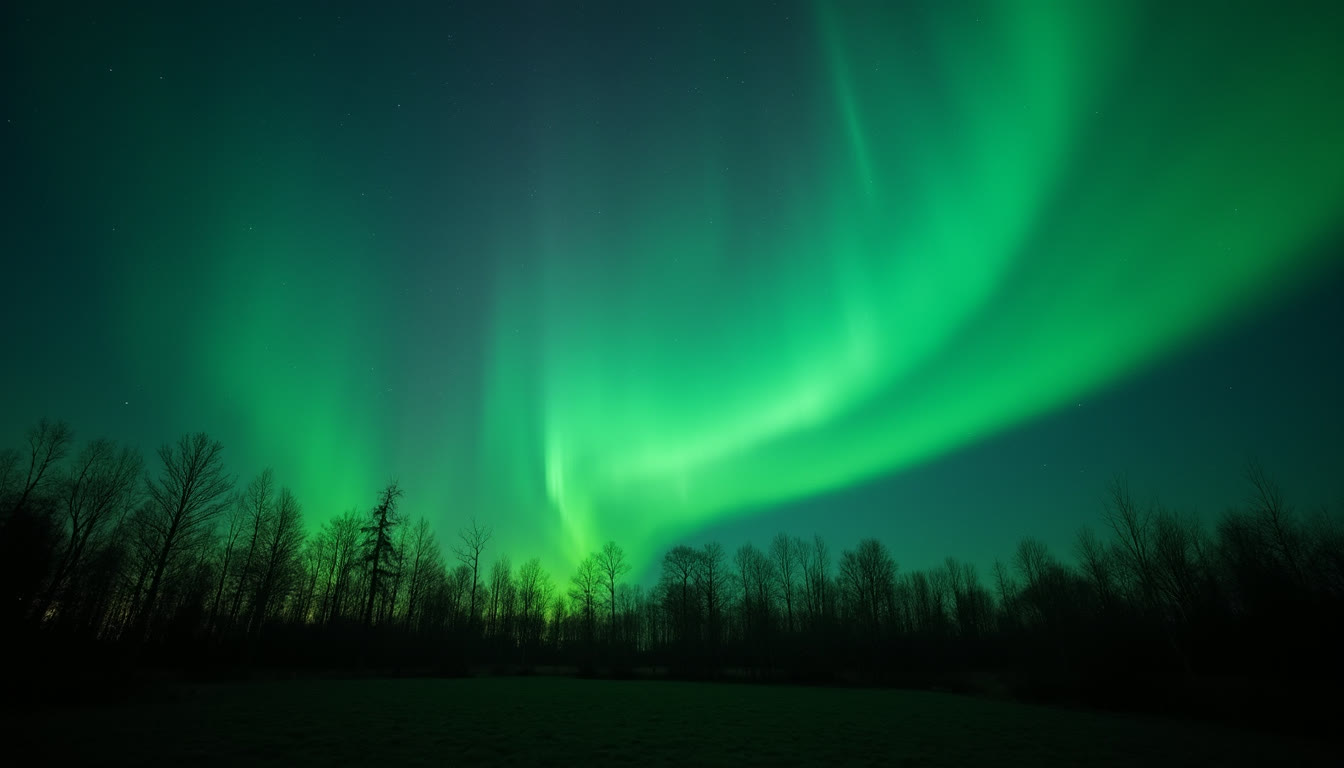
Vibrant green aurora borealis stretching across a dark night sky over trees

Widespread Aurora Visibility Across Britain

The Aurora Borealis was seen across the UK during the evenings of Friday 9 October and Saturday 10 October 2026. While these lights are typically seen near the Arctic Circle or in northern Scotland, they appeared much further south this weekend. BBC News reported that the phenomenon was visible in Wales and reached southern locations including Devon, Hampshire, and Kent on Saturday night.

Activity levels reached 600nT on Saturday evening, which according to BBC News made the aurora visible across the whole of the UK. This is a significant increase from the 200nT level that BBC News says is required for the aurora to be seen in northern regions without appearing in the south. Such high levels of activity allowed the lights to be seen in many southern counties.

The display follows a period of intense solar activity that has allowed the lights to be spotted in regions where they are rarely seen. The sightings in Kent, Hampshire, and Devon highlight how far the light can travel during periods of high solar intensity. These appearances have brought the celestial event to a much wider audience across the country.

The Science Of Solar Eruptions

The phenomenon is caused by solar eruptions from the Sun known as coronal mass ejections, according to BBC News. These eruptions release charged particles that are then captured by the magnetic field of the Earth. BBC News explains that these particles are directed into the atmosphere, where they cause the light displays seen by observers.

The Met Office said via The Guardian that solar wind travels at approximately 1m mph. "When these particles interact with Earth’s magnetic field – especially when the solar wind’s polarity is opposite to Earth’s – they are funnelled toward the magnetic poles.", according to the Met Office.

The colours seen in the sky are determined by the specific gases being hit by the particles. "As these energetic particles collide with gases in the upper atmosphere, they release energy in the form of light. Oxygen produces green and, at higher altitudes, rare red auroras, while nitrogen creates blue and purple hues.", according to the Met Office.
Sun Cycles And Solar Activity

The Sun is currently in a heightened state of activity as part of a natural 11-year cycle. This cycle affects how much solar activity is produced and how often eruptions occur. BBC News and The Guardian note that this 11-year cycle is a natural part of how the Sun operates.

Previous statements from experts indicated that 2026 would be a peak year for spotting the aurora. This heightened activity is directly linked to the solar cycle mentioned by BBC News and The Guardian. The current period of high activity has provided the conditions necessary for the widespread sightings observed this weekend.

The interaction between the solar wind and the Earth's atmosphere is a complex process. The speed of the solar wind, which the Met Office said is approximately 1m mph, plays a part in how these particles reach the planet. This movement of particles is a key component in the formation of the lights seen across the UK.

Tips For Observing The Lights

For those wishing to view the lights, BBC News suggests looking northwards and staying away from streetlights. Using a mobile phone camera can also be a helpful way to capture the display. This advice is intended to help people find the best conditions for seeing the aurora during periods of activity.

BBC News explains that cameras are useful because human rod cells do not perceive colour in low-light conditions. This means that a digital sensor may be able to pick up colours that the human eye might struggle to see in the dark. Using technology can therefore provide a clearer view of the various hues produced by the gases.

The different colours, such as the green from oxygen or the blue and purple from nitrogen, are part of the visual experience. While the human eye may have difficulty with colour in low light, the use of a camera can assist in documenting the event. These tips can help observers make the most of the solar activity.