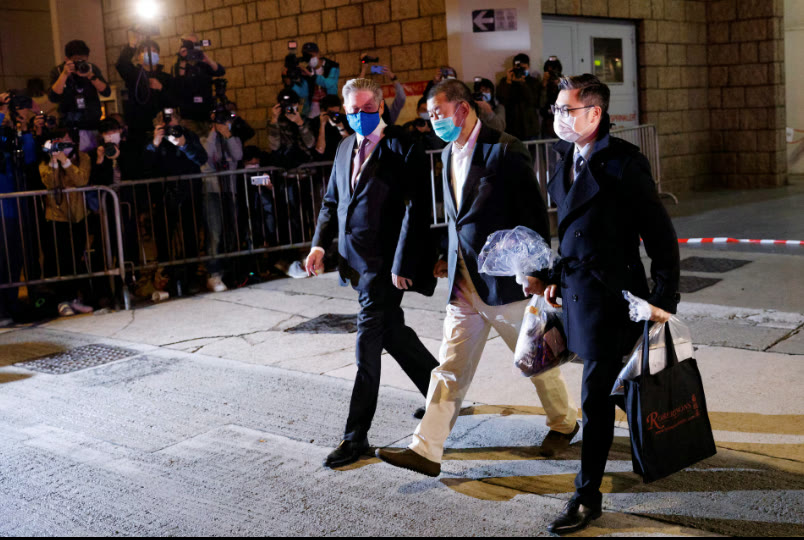
Hong Kong | 9 February 2026 — A Hong Kong court has sentenced pro-democracy publisher and media entrepreneur Jimmy Lai to a total of 20 years in prison in the city’s most high-profile national security case to date, intensifying international concern over press freedom and the direction of Hong Kong’s legal system under Beijing’s security framework.
Lai, 78, is the founder of the now-defunct newspaper Apple Daily and a long-standing critic of the Chinese government. He was convicted in December and sentenced today on two counts of conspiracy to collude with foreign forces and one count related to publishing “seditious” materials, offences prosecuted under Hong Kong’s post-2020 national security architecture.
UK Foreign Secretary Yvette Cooper responded to the ruling by condemning the sentence and reiterating the UK’s position on the case, calling for action on Lai’s situation as a British citizen.
What the court decided
Reuters reported that the court imposed a combined sentence of 20 years on Lai, treating him as a central figure in the alleged conspiracies. The charges relate to claims that he and others sought to “collude” with foreign powers and published material deemed “seditious” under Hong Kong’s tightened political and speech laws.
Associated Press described the ruling as the longest sentence handed down under the national security law to date, noting the case’s prominence internationally and its symbolic weight for civil liberties and media freedom in Hong Kong.
How the case reached this point
Lai’s arrest dates back to August 2020, shortly after Beijing imposed the national security law on Hong Kong following the 2019 protest movement. Prosecutors have framed him as a key organiser and financier in a broader network of activism and overseas lobbying.
The trial has been widely watched because it sits at the intersection of political speech, international advocacy, and journalism. Lai’s supporters and rights groups argue the prosecution effectively criminalises press activity and political campaigning that would have been protected expression in earlier periods of Hong Kong’s post-handover history.
Apple Daily and the wider media crackdown
Lai’s case is inseparable from the fate of Apple Daily, a popular tabloid-style outlet known for aggressive editorial stances and a strongly pro-democracy line. The paper shut down in 2021 after arrests of senior staff and the freezing of assets, developments that press freedom organisations and international observers have repeatedly cited as a turning point for media pluralism in Hong Kong.
Reuters’ profile coverage of Lai describes him as a “democracy firebrand” whose media empire became a major vehicle for criticism of Beijing and Hong Kong authorities. That notoriety, supporters argue, also made him a prime target once the security law created new offences with severe penalties.
International reaction: UK, media groups and rights organisations
The UK government statement issued today signals the continued diplomatic sensitivity of the case, particularly because Lai is a British citizen (a point repeatedly referenced in UK coverage and official responses).
Rights organisations described the sentence as an attack on free expression and a warning to journalists and publishers about the cost of dissent. Amnesty International UK, for example, condemned the outcome and urged the UK government to press for Lai’s release.
News organisations have highlighted concerns that the case adds to a growing perception that Hong Kong’s courts are increasingly constrained by the political objectives of the national security framework. The Guardian called the prosecution part of a years-long transformation in which dissent is being progressively suppressed.
What this means for press freedom in Hong Kong
The practical significance of the sentence goes beyond Lai’s personal fate. Press freedom advocates argue the case reinforces three emerging realities in Hong Kong’s post-2020 environment:
- Severity of penalties
National security offences carry extremely serious sentencing ranges, including life imprisonment for certain categories. Even when a life term is not imposed, long sentences can function as effective lifetime incarceration for older defendants. - Chilling effect on journalism and publishing
If editorial decisions, political commentary, or overseas advocacy can be framed as “collusion” or “sedition,” editors and owners may rationally avoid sensitive reporting, weakening investigative journalism and narrowing the range of permitted debate. - Institutional risk for media organisations
The Apple Daily closure demonstrated how enforcement action can rapidly become existential for a newsroom, not only through arrests but through operational constraints such as asset freezes, banking restrictions, and supplier or platform risk.
Beijing and Hong Kong authorities, however, maintain that the prosecution is about national security rather than press freedom, arguing that journalism is not a shield for criminal acts. This official position is repeated across state-aligned narratives and is a core point of dispute between governments and rights groups.
What happens next
Coverage indicates the sentence is likely to trigger further international pressure and could remain a point of diplomatic contention between the UK, the US and China.
Legally, Lai faces limited options in a system where national security cases have distinct procedural features and where courts have increasingly upheld strict approaches in security-related prosecutions. Reuters noted the case’s status as the most high-profile national security trial in Hong Kong so far, suggesting its precedential effect will be closely watched by lawyers, media groups and civil society organisations.